|
The Pillars
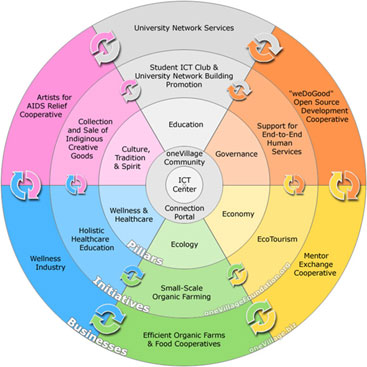
The pillars are the foundation for the OVI and the oneVillage.biz
social enterprise Network. The Wheel consists of six
pillars Economy, Ecology, Education, Health Care, Governance
and Culture and Tradition. The idea is to maximize existing
infrastructure and capacity, as part of the initial
assets based community inventory analysis. The
pillars, and the concentric rings around them, describe
the ecology of community revitalization (see above diagram).
The pillars are actually
basic areas of knowledge that people involved in the
process start from in developing their local network
and linking it to their global networks through the
Connection Portal. And this is where the Open
Digital Village comes in to play providing low cost
connectivity solutions in parts of the world where these
services are not commonly accessible.
The Knowledge Wheel is designed
to evolve from the core Pillar concepts to The white
labels in the lower left areas of the integrated
knowledge wheel diagram reflect the succession of developments
in each 'pie slice':
 |
Pillars (concept/think-tank);
|
|
Initiatives (concept
being incubated as a part of self-sustainable
local economic ecosystem); |
|
Businesses
(fully developed social enterprises that generate
value added ROI and can be used to replicate best
practices to other regions). |
When the village decides to make a difference
in one of the pillars, it starts an initiative,
for example, organic farming, usually on a shoestring
basis. As initiatives become successful, they may become
businesses – the outer ring – such as efficient
farms and cooperatives.
As these businesses develop, they are
incubated by the oneVillage.biz Network
and they evolve towards the outer ring of the Knowledge
Wheel developing a business oriented knowledge base
that can replicated to other regions that have similar
conditions and challenges locally as well as globally.
This encourages synergies between each
part of the community so that potential of each is maximized
towards increasing the overall quality of life in the
community.
|