Country Partners are
groups who are committed to the oneVillage Foundation
mission and who seek to implement this on a practical
in their home countries. They facilitate the development
of Cross sector partnerships at the local state and
national levels in their countries.
Learning
is a lifetime process. Sharing knowledge is a
form of empowerment. By teaching and learning
together, we promote peace.
Vision Education is not just about creating productive
workers it is about the well rounded development of the individual
so that this individual is empowered to function in a free
society for both his/her benefit and the benefit of the common
interest. The effective use of human intellectual capital
is vital to our success. A vision of a better world can only
tranform if it becomes a integral part of our lives. As we
realize our potential as human beings and in the process help
others to realize their own potential all over the world this
will have a cascading effect on the larger social movement
of which we are part. To meet the unprecedented challenges
of our age, we must develop educational systems that bring
together collective knowledge and expertise to promote sustainability
and social justice.
Current Reality and Challenges
Educational systems are pushed to the limit in emerging economies.
The demographic transition is bringing more children into
cities than most governments are capable of managing, while
many in rural regions do not have even the most basic educational
services available to them. Even those in school do not have
the most rudimentary teaching tools available and teachers
are not adequately trained or compensated for their work while
at the same at overburdened with huge expectations. Conventional
approaches involve continuing to focus investment on urban
areas and to develop and import educational approaches and
content from developed countries.
Education Divide
Education in many parts of the world
is a luxury
Approximately 120 million primary school aged children
do not attend school globally
150 million drop out after five years of education
80 million African children out of school
2 percent of Africa's school children go to college
Approach
This program will demonstrate on a practical level the compelling
nature of an integrated approach to sustainable development.
The major fields of this integration will be involve a complex
level of interaction which is why we are organizing an academic
program to develop knowledge bases that bring together innovative
thinkers in an holistic educational program that offer hands
on learning experiences promoting technology transfer and
training to developing regions that most need these technologies.
We will mobilize development resources through
a cooperative networked effort committed to advance education
in non-affluent parts of the world as rapidly as possible.
To reach the extremely ambitious MDC goals we need a whole
systems approach that goes beyond urban regions to provide
high quality social and economic services to people in all
types of human habitats:
Human capacity building at the community
level the corner stone
Provide safe and healthy schools and play environments
for children
High quality education for high quality jobs
New Professsional Model - The oneVillage
new professional model of development will base itself on
helping people to help themselves. The student needs to develop
the tools to learn and the openness to new perspectives that
result the evolution of both their personal and academic and
professional lives. A successful educational experience weaves
these two components together in an experiential experience—a
life long bond that melts together the theoretical with the
practical. Sustainable or restorative economics
and involves a consideration of many physical as well as social
measures that do not garner serious consideration in many
schools, governments or businesses. Social sustainability
is an expansion of the relatively straightforward quantitative
measures of success towards a restorative economy into the
realm of the qualitative—that is what do we need to
make us healthy, nourished human beings that are stimulated
by the environment and the people in our lives.
Holistic and Interdisciplinary Approach
to Education John Todd of Ocean Arks International
explains that in order to create and effectively manage sustainable
systems we need to develop an understanding of the world that
is nonlinear, interdisciplinary and multi-dimensional. This
integrated whole brain/whole systems process of thinking will
enable us to navigate our way through complex systems in a
way that intuitively allows us to select the information that
is relevant to our needs, rather than the current cumbersome
and highly structured approach that is the norm today. The
ICT augmented educational program will involve a series of
web-based teaching and interpretative presentations, which
will better explain the key role of ICT in teaching us to
“think like an ecosystem,” as the ecological designer
John Todd says.
Academia has an important role collaborating and coordinating
with businesses and nonprofits to promote an integrated sustainable
education model at the village level:
Ecological Design—Develop
sustainable organizational models, approaches and technologies
necessary to promote this type innovative type of economic
growth—including business, planning and sustainable
design
Ecological economics—Refine
the economic models and theories needed to sustain the
expansion of the restorative economy—economics
and finance
Integrative Studies—Promote
an interdisciplinary approach to sustainable development
based on a comprehensive, whole systems approach—integrative
studies
New Professional Model—Cultivate
a new mindset based on an expanded global social and
ecological consciousness—public and governmental
relations, advertising and marketing
Critical thinking - Another
aspect of this learning process is an emphasis on process
and the design of thinking processes rather than the accumulation
of knowledge through memorization. Modern systems change too
rapidly for us to really effectively justify from an economic,
social or cultural perspective much of the time spent on memorization
in conventional schools.
Experiential Learning - A
vision of a better world can only tranform if it becomes a
integral part of our lives. Theories and ideals remain little
more than lofty notions unless they are brought down to earth
so that they relate to the everyday struggles in people lives.
Give people an educational experience
they can use - practical practices that will work
including hands-on work in the field as well as in the
classroom
Get people using tools and feeling what it’s
like to build the soil
ICT and Education ICT - Support expanded
education programs, providing open and distance learning (ODL)
modules that can teach valuable skills of all sorts. NGOs
working with this technology can teach villagers how to use
the power of ICT described above. NGOs can also teach them
to how create their own content, and how to locate content
from others that meets their needs.
oneVillage Programs
OneVillage
Holistic Education Program
This program integrates cutting edge
best practices through the latest ICT technologies including
knowledgebases and multi-media presentations. However
the key is human development as part of a training program
that inspires people to realize their true potential.
oneVillage Initiative Back to the Root Training include
full immersion seminars that help to activate our innate
ability to seek out solutions combining both analytical
and intuitive/creative thinking.
University
Network Building Our
approach is to actively participate in IT societies
both in Nigeria and international forums to address
the importance of quality campus network to enhance
educational services for the students and the surrounding
communities. We share with OAU our global knowledge
and experiences in digital development as well as business
strategies to support its teachers for best educational
solutions via ICT.
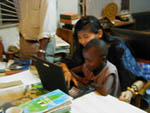
Youth for ICT Club
Development, Promotion and Consultation
We provide strategic planning and consultation to work
as one team with the student ICT club to expand their
learning as well as community development opportunities.
Storytelling An important of our educational program invovles
the use story-telling to build rapport and enthusiasm.
This includes celebrating the successes, creating proactive
solutions for the problems that show up and then sharing
them on the Web. Through storutelling we recognize and
honor Centers of Excellence, both in the demonstration
areas and in each cluster (village).
As we realize our potential as human beings and in the process
help others to realize their own potential all over the world
this will have a cascading effect on the larger social movement
of which we are part. SUsing Unity Centers as practical hands
on vehicles for social change we will reconfigure educational
systems to promote new understandings and new systems of development
dedicated to social and cultural revitalization that is locally
based but globally aware.
Objectives
Train students on how to effectively
convert Information Technologies (IT) and environmentally
appropriate technologies into tangible products that
have economic value
Emphasize process and the design of thinking processes
rather than the accumulation of knowledge through
memorization
Promote experiential Learning - educational
experiences people can use in their everyday lives
Create channel and forums to enable global wisdom
exchange
Empower Youth on IT education, entrepreneurial
training and develop platform for Youth to apply their
skills
CatchITYoung
is a program established by OVF Ghana in that establishes
ICT clubs for K-12 students in Ghana.
GRASSUP
NOW is a program started by a group of NGOs with the support
of the Commonwealth of learning a Canadian Foundation. Their
goal is to develop a ICT augmented program that improves awareness
of health care and nutritional issues with a particular focus
on women.
Proposals
Professor Akiwowo eLibrary
Relevant
Research
Downloads
For a more in-depth explanation of the methodology of the
OVF educational program download the OVF_Lifelong_Learning.pdf
Go here to read more about OVF's Open and Distance Learning
Program
OVF_Eco-NIC.pdf